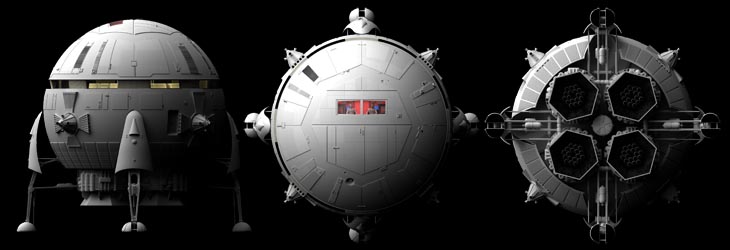
The N-1 Moon Rocket


Terminology

Just to recap here, to avoid confusion. Strictly speaking, the N-1 is just the first three stages. The fully assembled Moon rocket is the N1-L3. On top of that you have the four different versions that flew, the 3L the 5L the 6L and the 7L.  There were also test / breadboard models, like the 1M1.

Building the model

I started with no real clear idea of how far I was going to take it, but fairly confident I had enough information to make a decent job of the model. After all, if no references were available, no-one would know if I made stuff up, worst case!

The shape was very distinctive, and I could only find a few other attempts at modelling it in software, so I figured I'd have a god chance of making the best model yet done.

The previous project had been much smaller, it was the V-2 rocket, (available for free download on my downloads page, see the bottom of this page). For that I had tried to ind the best way of modelling things, with the help of various online forums. It took longer, but I really learned a lot.

One of the most important things that makes life easy when modelling is good plans. These can be used as a backdrop to the modelling software in almost every case, (certainly in Lightwave 3d, my prefered software). The main shape of the rocket is very simple, it's basically a sequence of trucated cones, so with the plans from I had got from the net, (available in one of the galleries here), it was off to a flying start.

In my experience it is not too difficult if you have to redo the more minor parts, but if you get the overal shape wrong, even a small error can lead to a large amount of reworking later.

A problem I knew I would have from the start was the base. It has round holes cut into a smoothed surface, and this is really horrible to model. The problem is that the cuts made tend to make for extremely irregular smoothing.

Fortunately the helpful chaps over at the Lightwave 3d group, came to the rescue, and explained how to do it. If you are interested yourself, here's a link to the thread. This contains a load of stuff on the detail of how I modelled the thing, from start to finish. It's a very helpful forum, squarely centred on Lightwave and with a strong bias in subject matter towards science fiction and space.

Other places I received support and encouragement included the main lightwave forums the Space Modellers Yahoo Group, (mainly aimed at physical models, but very knowledgable, and helpful with references), and the International Association of Astronomical Artists list, (only open to members).

Choosing polygon counts:

A minor point, but one that will make life easier – how many sides should you use when modelling something like this? It is always a good idea to keep the polygon count as low as possible without affecting the end quality, but how to choose?

I wanted to get fairly close to the rocket for some shots, so that meant I would need a fairly large number. In particular if you look at the lip of a cylinder at a shallow angle, it can really emphasize the polygons. A less obvious factor is adding repeating details.

By this I mean things like the ring of catches around the lip of the first stage, or the repeating pods around the side, even the engines. It is much easier to get the positioning right if each instance lines up with the underlying polygons in the same way. It’s perhaps easier to think of with smaller numbers – think about positioning 8 objects around a hexagon. It gets messy if you keep them evenly spread as each one is in a different position in relation to the flat sides.

A handy trick for maximum flexibility is to use a multiple of 12 or 24 – there are lots of ways to divide this up evenly, so no line-up problems. In this case I went for 144 sides.

Colour.


One controversial point that came up was the colour of the N-1. Several different colour schemes were launched, notabley:
For a time I was convinced that there were no completely white ones, only those where the dark quarter was turned away from the camera. As you can imagine, it is often very difficult to work out the orientation!

But at least one shot of two apparently white rockets showed a dark edge nearest the gantry. And as only four were launched that seemed to account for 3 of them...

Fortunately Pjotr, my helpful expert from Lithuania, was able to explain that one of the rockets in the shot wasjust a test model, and was never intended to fly. If you look closely, you will see one of them has no escape tower.

The other controversy about the colour is exactly what the colour is that I have refered to as 'Dark'. In every case I have seen in a museum, it is done as dark green - a colour which is generally copied by amateur modelers. This is also the colour refered to in the book "Rockets of the World", (currently out of print), widely viewed as the definitive reference work for rocket modellers.

Most photos have extremely subdued colour, and are not a lot of help - also all the famous colour ones come in versions which have ben processed in a wide variety of ways, to make things even more confused!

Here are some examples, to give you an idea of the problem.

(Add various thumbs and link through to the galleries)

I was fortunate enough to discuss this on the Space Modellers group, where (????) who built the model in London's Science Museum said if he was doing it again he would paint it grey. The very handy card model from Currell is dark grey too. Again, Pjotr was able to give a definitive answer - he said he had spoken woth people who worked at Baikonur at the time, there was definitely no major green there. I asked why his own model had a green base to the second stage, and he explained he too had started out thinking the other way, but had been convinced later, when it was too difficult to get in and change the colour, so only the outside had been corrected!

You may notice if you look back through the stages of my own models development that it went through a period of fading from glossy rich green, to olive, to a colour very close to grey! I decided to give the slightest tinge of green to the grey, so it would look a bit like the photos.

Differences between the various craft.


This is not intended to be a definitive guide, but my best understanding. As always, if you think I have something wrong, I welcome corrections!

There were four N-1 rockets that actually flew, but several other test models were built, and two at the end of the program where no launch was ever attempted after the program was cancelled.

I am trying to concentrate on the four that actually flew, and thse came in three different colour schemes.

The first launch is the one most often modelled, it has the whole of the first two stages as dark grey, and half of the third stage. This is the N1-3L

The second launch has one quarter of the first and second stages dark grey, and the rest of the rocket white. (The N1-5L). There are also several photos of a test version in these colours - I think that the lack of an escape system is a big clue it is a test rocket, but I am not sure if this is definitive.

The final two launches, (The 6L and 7L), were essentially all white for the main hull components.

There are also some physical differences between the models. Earlier craft, (The 3L and th 5L), had a wider sharp edged skirt, which was trimmed in later vehicles. Also the 'pods' on the side of the stages were made more streamlined. These are actually covers for the pipes taking the kerosene from the upper spherical fuel tank around the lower liquid oxygen tank. (You will notice that on the upper stages there is one pod per engine). The first two launches, the 3L and the 5L had the more blocked, less streamlined pipe covers.

These shape differences are well described in these diagrams.

When I get this done I will render side-by-side images of all versions for comparison.


N-1 Top N-1
History
N-1
Features
Launch
site
My
Model
N-1
Galleries
N-1
Links


All rendered graphics © Nick Stevens. You may use the in-line illustrations on your own web pages, provided that you give me a credit, and provide a link back to my N-1 home page. Very high resolution versions of all rendered images, and animations, are available for a fee. Contact Nick Stevens at the e-mail address below for details.

Thanks & Credits


These web pages would not have been possible without the help of many people who provided information, and pointed me the right way. Many run web sites which are listed in the LINKS section.

My particular thanks go to the people hanging out in the IAAA mailing list, the space modelers list, the forums at Novosti Kosmonavtiki, and specifically:

If you found this page interesting, you may also like to see some of my other pages on this web site - please explore the links on the buttons below to see more of my pages:

Click for the CGI gallery Click for the gallery top level. Click here to see my space graphics. Click here to see my downloadable files.
Click here for the top level of my panoramic galleries. Click here to see my photo galleries Site Index Send me a message by Email
3d environments you can pan around. Video clips for your viewing pleasure. An index to tutorials on this site. Small animated GIF images.