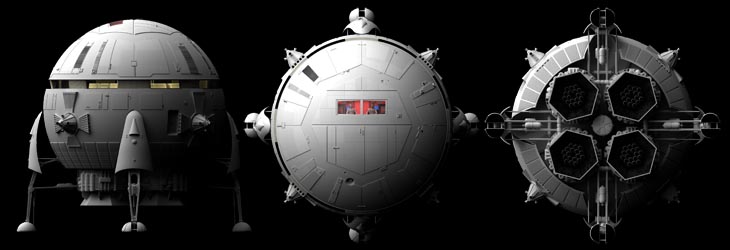
The N-1 Moon Rocket - Features


Here is an overview of the major sections of the N-1 rocket, from top to bottom. This is based on the 3L version, (the first attempted launch model). These pictures will be updated as my model progresses.

Sections of this page:


Major components:

Note you can click on the number in blue, to go to a more detailed description.
Top view of the N-1 Top view of the N-1
The escape rocket system The escape rocket system
The fairing covering the LOK The fairing covering the L3 assembly.
Within this are:

  • Stage 4 / Block G.
  • Crash Stage / Block D.
  • LK Lander / Block Yeh.
  • The Lunar Soyuz /LOK. (Lunniy Orbitalny Korabl)
The third stage of the N-1 The third stage of the N-1, Block V. (Note that the Cyrillic letter equivalent to English "V" is written as "B" This was powered by four NK-21 rocket engines.
The second interstage The second interstage
The second stage The second stage, Block B. This was powered by eight NK-15V rocket engines, an adaptation of the NK-15 used in the first stage with a longer bell to function better at high altitude. Note that the Cyrillic letter written as "B" is pronounced "V", so you will sometimes see this on the web as the NK-15B.


The first interstage  The first interstage
The first stage, Block A The first stage, Block A. This uses a whopping 30 of the NK-15 engines.
Base view of the N-1 Base view of the N-1. Note that the ring just inside the outer rickets is used to hold the rocket in place on the launch pad, and is left behind when the rocket takes off.

Note that the symmetrical arrangement of the engines means that they can be shut down in pairs in the event of problems.
Reference Ring / clamp ring, alignment system, and connectors.

Other sections greyed to clarify.

N-1 features.

This page considers the key components on the N-1 rocket, and describes them.

Overall structure.

The stages of the N-1 are normally called ‘blocks’ and are lettered from the bottom up in the order of the Russian alphabet. Thus the first stage is Block A, the second Block B, and the third Block G.

These are correctly make up all of the N-1, the additional stages should strictly speaking be treated separately. The full assembly is generally called the N1-L3.

Above block G is a fourth stage, Block V, then the sections that would actually go to the moon. This assembly is the LOK, or Lunniy Orbitalny Korabl.

In the upper sections were the lander, (a one man affair, much smaller than the US Lunar Module) – this was known as the Lunniy Korabl, and the orbiter, which was something of a stretch version of a Soyuz capsule.

All of the first three stages or blocks are based on a smaller spherical tank of kerosene above a larger spherical tank of liquid oxygen.

Section by section:


Overhead View

This is CGI image from directly above the N-1. It is orthographic, i.e. without perspective.

Escape Rocket System

I did not find any really good images of the escape rocket system. This is used to pull the manned sections away in the event of serious problems with the main rocket. It consists of two rings of small rockets, the ones near the base of this section are clear, less clear is the ring of very small ones tucked just under the top section.

The upper set is used to remove the escape system if all goes well, and the bigger rockets have enough power to pull the capsule free.

This upper set of small rockets has exhaust nozzles of two differing lengths - short on one side, longer on the other. This results in an uneven thrust, so that when the escape system is jetisoned with the smaller rockets, it is pulled out of the path pf the main rocket and a collision is avoided.

LOK Fairing

This covers the section that actually goes to the Moon, the L3 part of the N1-L3. LOK is short for Lunniy Orbitalny Korable, or roughly "Lunar Orbital Craft". More modelling to do here! There was also an inner fairing, that came off later in the missions.

Stage 3 / Block V

Much more modelling work to be done here.

Second Interstage

This part separates the second and third stages. The main part of it remains attached to the Second Stage / Block B when that drops away.

Second Stage / Block B

The second stage on the N-1 rocket was never flown separately, though one of the test flights came within seconds of stage separation.

First Interstage

This is the part that goes between the first and second tages. Note also the parts that provide a connection for signals between the first and second stages. As soon as I get round to modeling them, that is...

First Stage / Block A.

The first stage of the N-1 was the most power stage ever built for any rocket, considerably more powerful than the first stage of a Saturn V.

The first stage of the N-1 was considerably bigger, and more powerful, than the first stage of a Saturn V. However the Saturn V could lift more weight into orbit, mainly because it’s third stage was a lot more efficient, as it used the much trickier but more effective fuel, liquid hydrogen.

The first stage weighed 200 metric tonnes when empty, and approximately 1900 metric tonnes when fully fuelled.

The most obvious feature of the first stage is the huge number of engines, no less than 30 of them! Originally there were intended to be 24, but six more were added at a fairly late stage in the design.

A major problem in making a rocket as powerful as the N-1 or the Saturn V is the sheer power that the first stage engines must handle. The Saturn went for five extremely large engines, which were extremely difficult to develop. The Soviet solution was to use large numbers of smaller engines, and accept the challenge of routing fuel to them all.

This was a major difficulty in developing the N-1, and is widely considered to be a key reason for its failures. My own feeling is that this is a little unfair – the N-1 had much less funding than the Saturn, and I think it is doubtful if the other approach would have succeeded.

The engines were controlled by a system called ‘KORD’ which was meant to stop engines before they caused trouble. If one engine had to be shut down, the opposing one would also be stopped to preserve stability, and the remaining engines would burn for longer to make up for lost thrust.
In that shot the arrow head like features on the side of the hull are antenae, used to send telemetry to the ground.

Fuel Line fairings:

The long structures down the sides of the first three stages are another distinctive feature of the N-1. They are actually covers from the fuel lines that carry kerosene from the upper tank around the lower tank of liquid oxygen, to the engines. The narrower ones carry fuel to two of the outer engines, the wider ones also have a fuel line to one of the inner ring of engines.

N-1 Rocket base

The base has two distinct appearances in photos - in the factory it looks simple, dark and shiny. Once the rocket is transported to the plan it is white with many dark spots. I think the appearance once it has left the factory is due the the heat shield being attached. This is to protect the base of the rocket from the fierce heat of all the engines, particulalry because the exhaust was deliberately fuel rich, to add extra thrust.

Grid Stabilisers:

One of the more unusual features of the N-1 is the set of fourgrid stabilisers, arranged around the base of the  first stage. These are used to stabilise the path of the rocket - they are not so unusual on missiles. They fold up for when the rocket is being transported.

Reference Ring / Clamp Ring.

This part is the section just inside the outer ring of engines. It starts attached to the rocket in the factory, and clamps it down onto the launch stand. It is left behind when the N-1 rocket is launched..

Alignment System


Note the four small oblong structures around the base of the rocket, that partly obscure some of the engine bells. This system shows very well in most pictures of the base of the rocket. (link).

And here's a render of a model, with the alignment structures indicated by green arrows.


My thanks to the forum member on Novosti Kosmonavtiki forums, who identified these as plates for the U24 AK (ultrasonic system controls front RN N1). The main purpose of the system is to ensure that the rocket is placed on the pad perfectly vertically.

Electrical Connections


There is a red assembly at the top of the rear of the rocket, clearly visible in many factory photos, and the rendered image above. This provides electrical connections between the rocket on the launch pad, and external control systems. The red sections are protective covers for the electrical sockets, to ensure that the more delicate parts are not damaged on their way to the launch pad.

It is worth noting that all red elements on all Russian and Soviet rockets are removed before launch. The bright colour makes it easy to check that this has been done.


Variations between models:

Several versions of the N-1 were made. These are illustrated below. (The illustration will be replaced as the models improve). The key differences are:

Colour:

As can be seen, the first two models had grey sections, (more on the first variant, the N-1 3L). Also note that the colour IS grey, not green as it is sometimes shown. The last two models had all major visible sections coloured white. The darker sections of the N1-5L is not always visible - look for the exposed sections of the fuel tank, between the interstage grid. Is this is dark, you are looking at the 5L.

Fuel line fairings:

The covers for the fuel lines, (the extended pods down the side of the craft), were streamlined more for the 6L and 7L variants. They are blunt on the 3L and 5L. This difference is most visible on the first stage.

Skirt:

The edge of the skirt at the base of Block-A, Stage 1, is sharp on the 3L and 5L versions. On the 6L and 7L this was trimmed, and is blunt, to reduce drag.

Heat Shield:

The first of the N-1 launches, the 3L, did not have any special heat protection on the base, but telemetry from the unsuccessful flight indicated a potential problem. So all subsequent flights had addional sheilding, to help protect the rocket from the extreme heat of the fuel rich exhaust burning behind.
On the left no heat shield, on the right the heat shield held in place by bolts with black plastic heads.

Lumps:

I am not sure what they are, but for the 6L and 7L versions, there are two slightly streamlined lumps attached on the edge of the block-a skirt, on the part which is on top when the rocket is transported. They are close to the edges of what I believe is a connection asembly that is left on the pad, so I suspect they are part of the system that relays information about the rocket on the pad.

Test Versions:

Several N-1's were made that were never intended to fly, but were used for testing the pad systems. I think these can be safely identified by the missing escape system.

Illustration of the differences betwen different N-1 models.

This diagram shows some of the differences well.


N-1 Top N-1
History
N-1
Features
Launch
site
My
Model
N-1
Galleries
N-1
Links


All rendered graphics © Nick Stevens. You may use the in-line illustrations on your own web pages, provided that you give me a credit, and provide a link back to my N-1 home page. Very high resolution versions of all rendered images, and animations, are available for a fee. Contact Nick Stevens at the e-mail address below for details.

Thanks & Credits


These web pages would not have been possible without the help of many people who provided information, and pointed me the right way. Many run web sites which are listed in the LINKS section.

My particular thanks go to the people hanging out in the IAAA mailing list, the space modelers list, the forums at Novosti Kosmonavtiki, and specifically:

If you found this page interesting, you may also like to see some of my other pages on this web site - please explore the links on the buttons below to see more of my pages:

Click for the CGI gallery Click for the gallery top level. Click here to see my space graphics. Click here to see my downloadable files.
Click here for the top level of my panoramic galleries. Click here to see my photo galleries Site Index Send me a message by Email
3d environments you can pan around. Video clips for your viewing pleasure. An index to tutorials on this site. Small animated GIF images.